
By the Leigh Fibers Team
A few weeks ago, Daniel Mason shared his perspective that one of the most significant barriers to textile circularity is the lack of scalable end markets for recycled textile feedstocks.
We agree.
The textile industry needs more products designed around recycled materials, particularly blended textile streams that currently have limited recovery options.
But there is another important question worth discussing:
What ultimately creates demand?
Across manufacturing and commercial markets, one lesson holds true: demand is rarely created simply because something is environmentally beneficial.
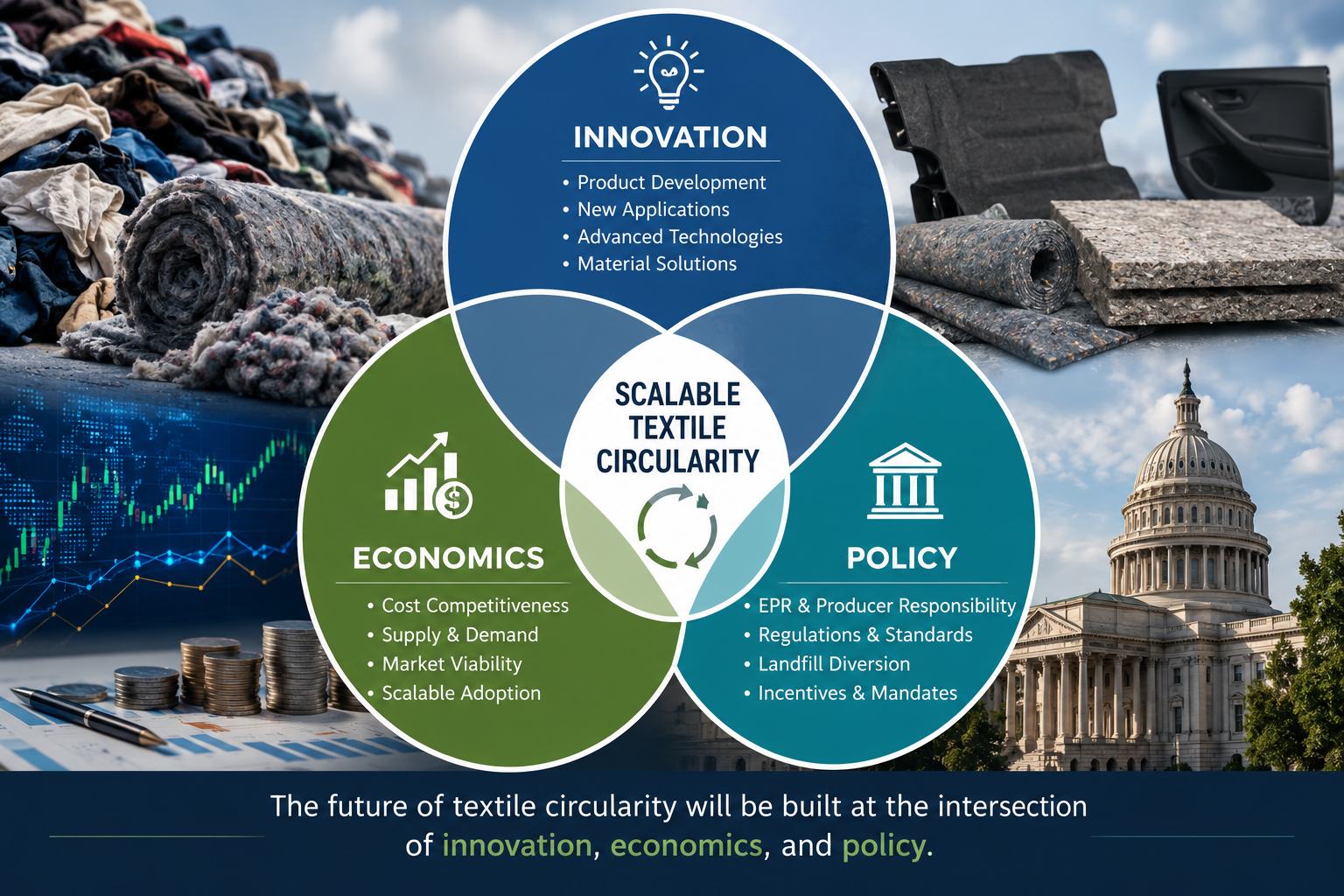
Demand is typically driven by economics, performance, regulation—or some combination of the three.
Understanding that reality may be one of the keys to predicting where textile recycling goes next.
The Market Wants Recycled Content—With Conditions
Over the last decade, sustainability has become an increasingly important topic for brands, retailers, manufacturers, and consumers.
Most organizations publicly support recycling initiatives and many have established ambitious sustainability goals.
Yet when recycled materials move from marketing presentations into purchasing decisions, a familiar set of questions emerges:
- Does it perform as well as the existing material?
- Is supply reliable?
- Can quality remain consistent?
- Does it cost the same—or less?
Those questions are reasonable.
In highly competitive markets, manufacturers must balance sustainability goals with product performance, customer expectations, and profitability.
The challenge is that many recycled material solutions are still competing against highly optimized virgin material supply chains that have benefited from decades of investment and scale.
Sustainability Alone Rarely Creates Scale
One of the lessons repeated throughout industrial history is that environmental benefits alone rarely drive widespread adoption.
Large-scale recycling systems tend to emerge when economics support them.
Aluminum recycling grew because recovered aluminum has value.
Paper recycling expanded because recovered fiber became an important feedstock for paper mills.
Lead-acid battery recycling achieved extraordinary recovery rates because the economics worked throughout the value chain.
In each case, sustainability was important—but economics ultimately enabled scale.
The textile industry is still working toward that same equilibrium.
The Quality Challenge
Another reality that deserves discussion is the relationship between recycled content and product performance.
Consumers may say they want recycled products, but very few are willing to accept lower quality, reduced performance, or higher prices in exchange.
Brands understand this.
Manufacturers understand this.
And ultimately, consumers reinforce it through purchasing decisions.
For recycled textiles to achieve widespread adoption, solutions must continue improving in ways that deliver both sustainability and performance.
The goal cannot simply be recycled content.
The goal must be recycled content that creates value.
Will Regulation Become the Catalyst?
One area that may significantly influence the future of textile recycling is public policy.
Globally, governments are becoming increasingly concerned about the growing volume of textile waste entering landfills.
Extended Producer Responsibility (EPR) programs, landfill diversion initiatives, collection mandates, and circularity requirements are already emerging in various markets around the world.
As landfill capacity becomes more constrained and waste volumes continue to grow, it is possible that regulation—not voluntary market adoption—will become the primary catalyst for the next phase of textile circularity.
Whether one views that as positive or negative, it is a reality worth considering.
Historically, major environmental improvements have often resulted from a combination of market innovation and policy intervention.
The textile industry may follow a similar path.
Innovation Still Matters
None of this diminishes the importance of developing new end markets for recycled textile feedstocks.
In fact, it reinforces it.
If future regulations increase recovery requirements, the industry will need far more applications capable of consuming recycled textile materials than exist today.
The companies developing those applications now may be the ones best positioned for success later.
That is why innovation, product development, and market creation remain so important.
Looking Ahead
The future of textile recycling will likely be shaped by multiple forces working together:
- New product development
- Improved recycling technologies
- Better collection and sorting systems
- Market economics
- Consumer behavior
- Public policy
No single solution will solve the textile waste challenge on its own.
But by understanding the economic realities behind adoption, we can have more productive conversations about what is required to move the industry forward.
At Leigh Fibers, we believe innovation and market development are essential. We also believe sustainable solutions must ultimately work in the real world—where performance, economics, and scalability matter.
The future of textile circularity will be built at the intersection of all three.